HumanTrue Sim
Test the study before you build it.
HumanTrue Sim tests whether a proposed study is coherent, reachable, and operationally plausible while the working system remains private.
Two distinct questions
First, can it run? Then, how might it perform?
HumanTrue keeps deterministic design verification separate from probabilistic population and performance assumptions. The distinction makes every result easier to interpret and defend.
Design feasibility
Checks Schedule of Activities completeness, state reachability, end-of-study paths, concurrency, guards, and Biomedical Concept resolution. No recruitment or behavioral assumptions are needed.Population-conditioned performance
Applies explicit distributions and assumptions to study enrollment, burden, capacity, discontinuation, cost, and completion behavior.Scenario comparison
Changes one or more controlled inputs and compares effects without losing the baseline, provenance, or replay path.
HumanTrue Simulation Model (HTSM)
A working study model, not a scripted animation.
01
Design integrity
Tests timing, dependencies, logical reachability, and complete study paths.02
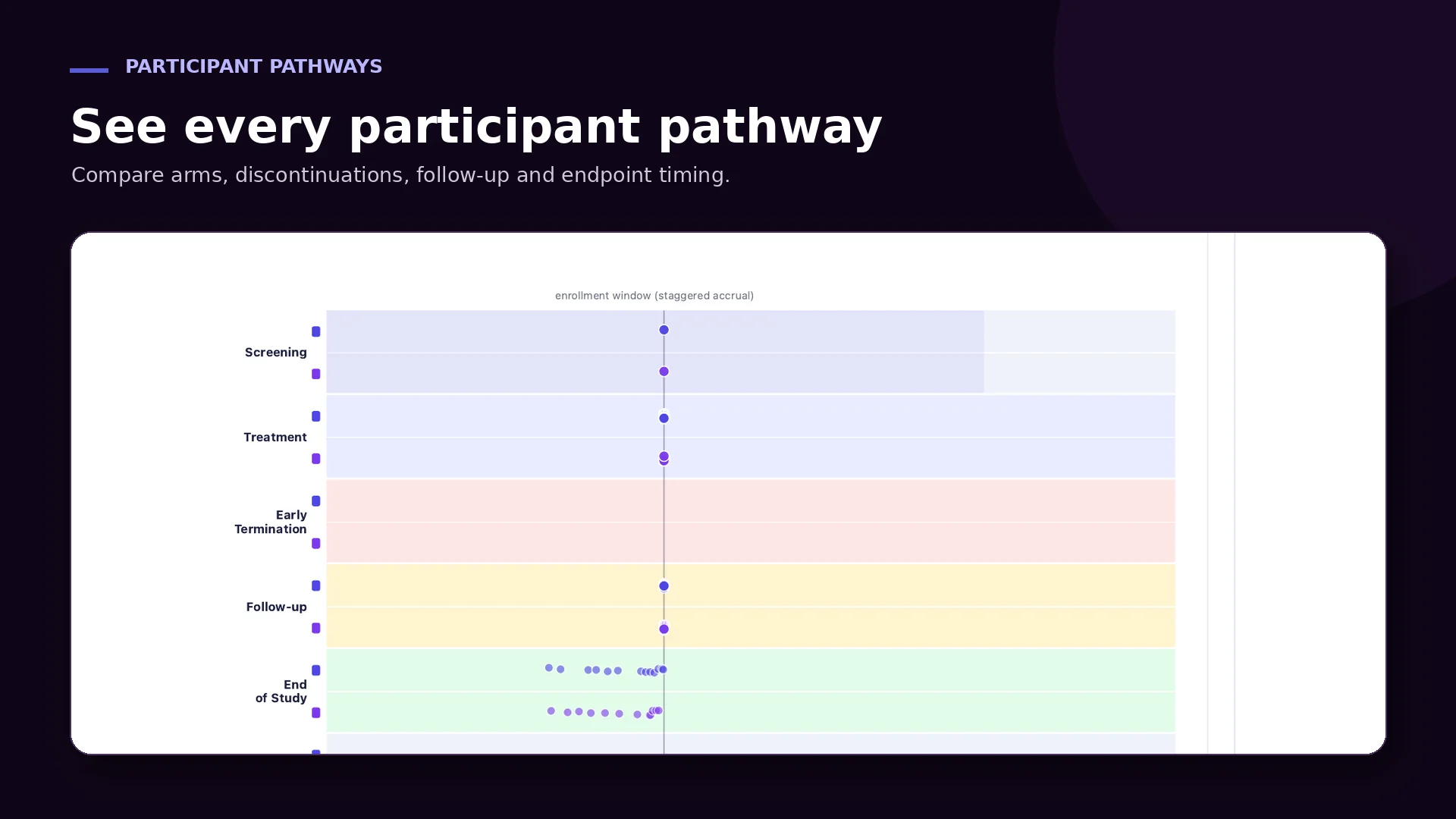
HTSM participant journeys
Shows how synthetic participants move through study events, branches, and dispositions.03
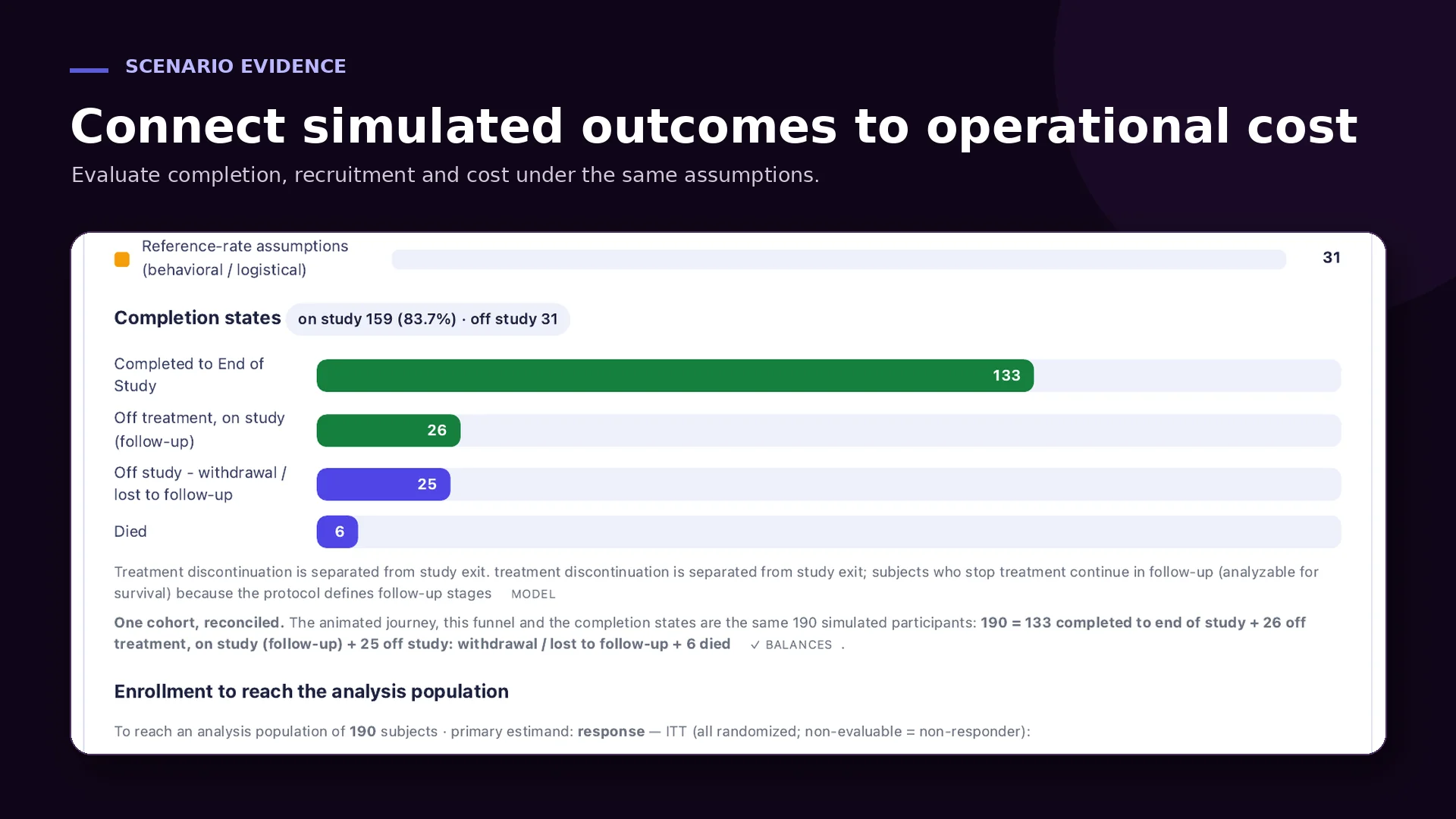
Scenario evidence
Compares controlled assumptions about population, burden, recruitment, cost, and completion.04
Reproducible results
Retains the inputs, versions, assumptions, and replay evidence needed to defend each result.
Simulation evidence
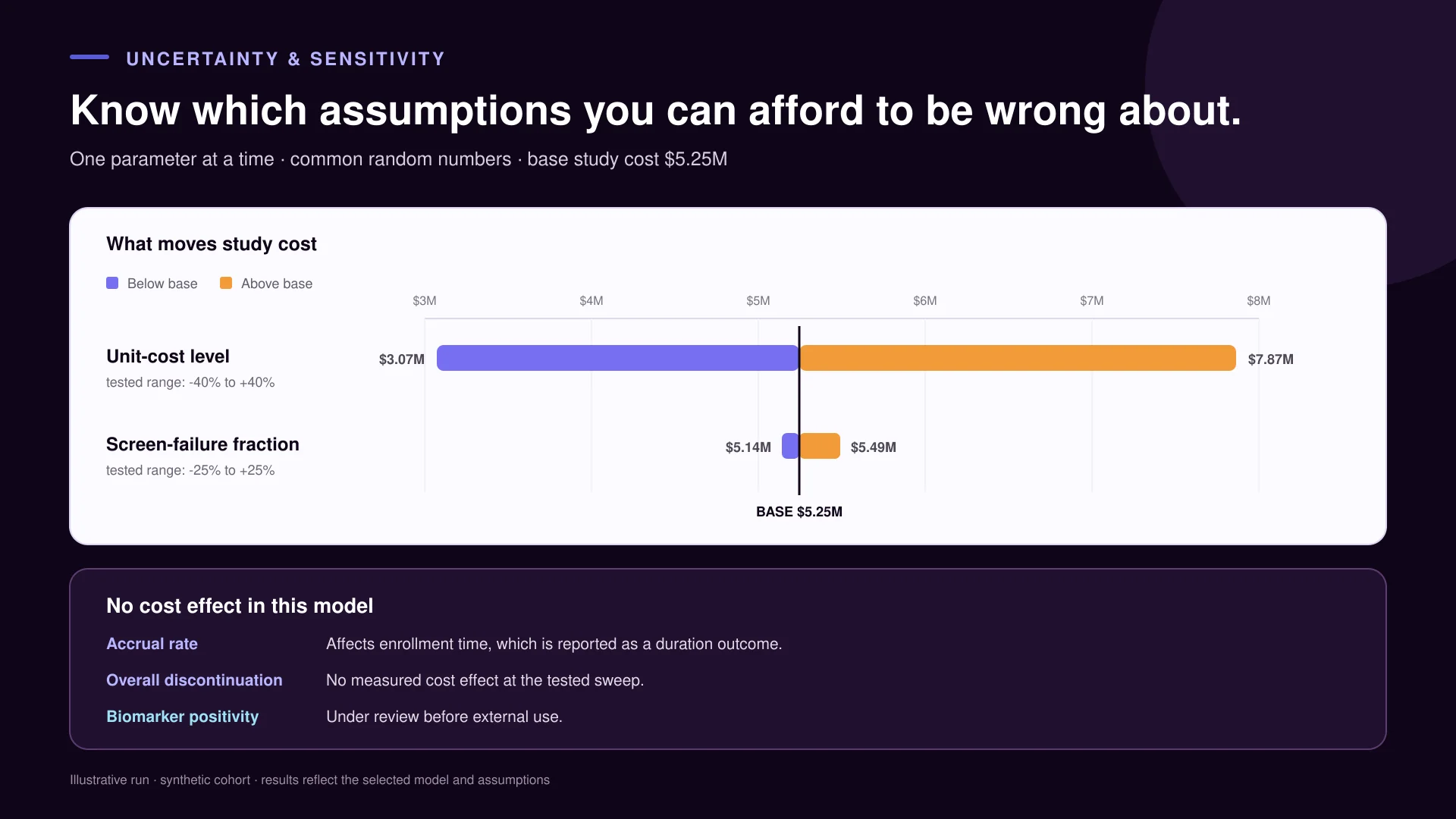
See the study from structure through uncertainty.
These flattened views demonstrate the evidence produced by the model while the working simulator remains private.
Patient study journey
Play, scrub, filter, and follow individual participants through protocol states and events.
Reachability & integrity
Inspect the complete state graph, discontinuation branches, and End-of-Study termination.
Population & accrual
Review cohort outcomes, recruitment curves, disposition, cost, and assumption sources.
- Curated evidence views cover design feasibility, schedule, execution integrity, population, recruitment, disposition, cost, reports, and provenance.
- Every simulated participant can be replayed from starting attributes through guards, transitions, and final disposition.
- The evidence bundle makes the run reproducible rather than merely visually plausible.
Start with one protocol