Digital protocols
Protocols should be digital. Start with the ones you have.
No confidential protocol needed to start: any study with a protocol posted on ClinicalTrials.gov will do.
What you get
One structured protocol, ready to use.
- A validated USDM 4.0 file: objectives, endpoints, estimands, eligibility, arms, epochs, visits, activities, and schedule timelines.
- Biomedical concepts mapped to CDISC terminology, with options for custom mappings.
- Every value linked to the protocol passage it came from, inside the file.
- A review interface, so your team approves each section against the source.
- An EDC-ready study build, reconciled with your form and folder library.
Unstructured content
- Protocol, as written (Word or PDF)
Semantic data
- Extraction and analysis (reviewed by people)
- Integrity checks (optional human review)
Structured data
- USDM (reviewed by people)
- SAP, ICF, EDC build, and more (reviewed by people)
Where it pays off
Value now, not when every protocol is born digital.
Faster study start-up.
Start the EDC build from the approved protocol instead of re-keying the schedule of activities by hand.
Amendments without starting over.
See what changed from build to build. Mapping decisions carry forward, so only the changes need attention.
USDM without re-authoring.
Put protocols already approved or in flight into USDM now. No new template, no rewrite.
One source for what comes next.
The same structure feeds the SAP, the ICF, and the systems that run the study, each traceable to the protocol.
Why you can trust it
Valid is not enough. It has to be true.
Conformant
Every file is checked against the CDISC DDF conformance rules for USDM 4.0 as it's produced, by the same validator we offer below.
Traced
Every value references the protocol passage it came from and the reason it was read that way. A reference that can't be resolved fails the file.
Reviewed
Your team approves each section against the source, with every edit logged and each reviewer recorded before downstream use.
Measured
Output is scored against known-good answers written by domain experts, across protocol types, so a regression is a failing test, not a surprise.
No confidential protocol needed
Start with a public protocol.
Pick
Choose a study on ClinicalTrials.gov.
Send us the NCT number of a study with a posted protocol, ideally one close to your therapeutic area or design.Digitize
We turn it into USDM.
You get the USDM 4.0 file, its validation report, and the source reference behind every value.Review
Walk through it together.
Check the result against the protocol in the review interface. Then decide whether to try one of your own.
Validator
Check any USDM file on your own machine.
usdmv, on the command line
- A single program for macOS, Linux, and Windows, with nothing else to install.
- Validates a large USDM file in a fraction of a second, so it fits in scripts and CI.
- JSON output, with the location of every issue in the file.
Offline, in the browser
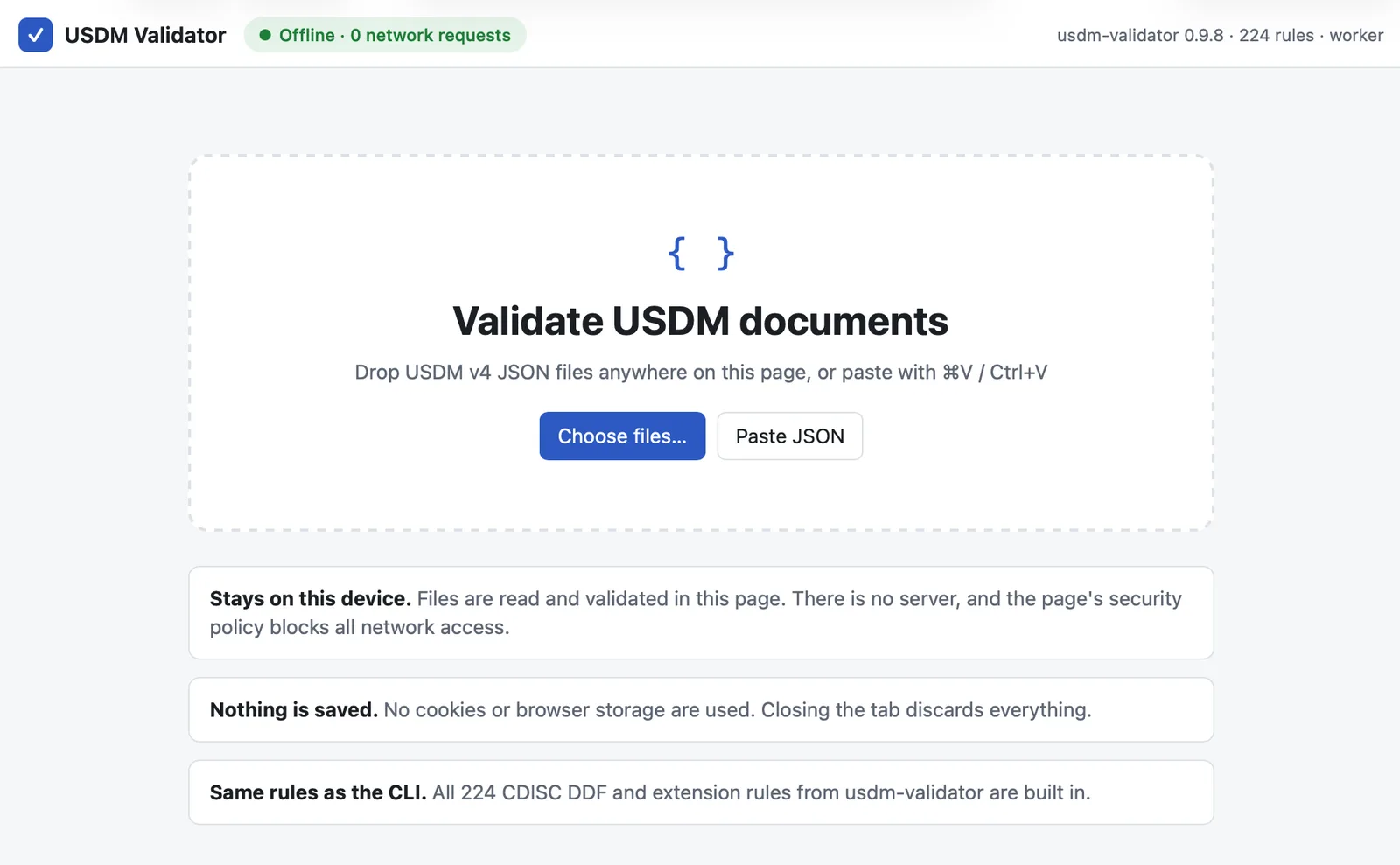
- One HTML file. Open it in any modern browser: no install, no server, no account.
- Files never leave the device. Once loaded, the page makes no network requests, and its security policy blocks them.
- Copy it anywhere, including a machine with no internet access.
$ usdmv protocol.usdm.json | jq .metadata
{
  "validator": "usdm-validator-ts-0.9.8",
  "standard": "USDM",
  "standardVersion": "4.0",
  "rulesExecuted": 223,
  "rulesSkipped": 1,
  "executionTimeMs": 144.749
}
Standards
Built with the standards community.
USDM Governance Group
HumanTrue CTO Bill Lynch is a member of CDISC's USDM Governance Group, which oversees the ongoing development, quality, and consistency of the model.
usdm-ts (open source)
TypeScript types, Zod runtime schemas, the JSON Schema, and a CDISC codelist index for USDM 4.0, generated from the DDF Reference Architecture. Apache 2.0.
CDISC US Interchange 2026
"What It Actually Takes: Lessons from Production USDM Adoption and the Path to Digital Data Flow." Session 6B, Denver, October 2026.
Digital protocols