HumanTrue Study Assistant
Your study knowledge base, available to every authorized role.
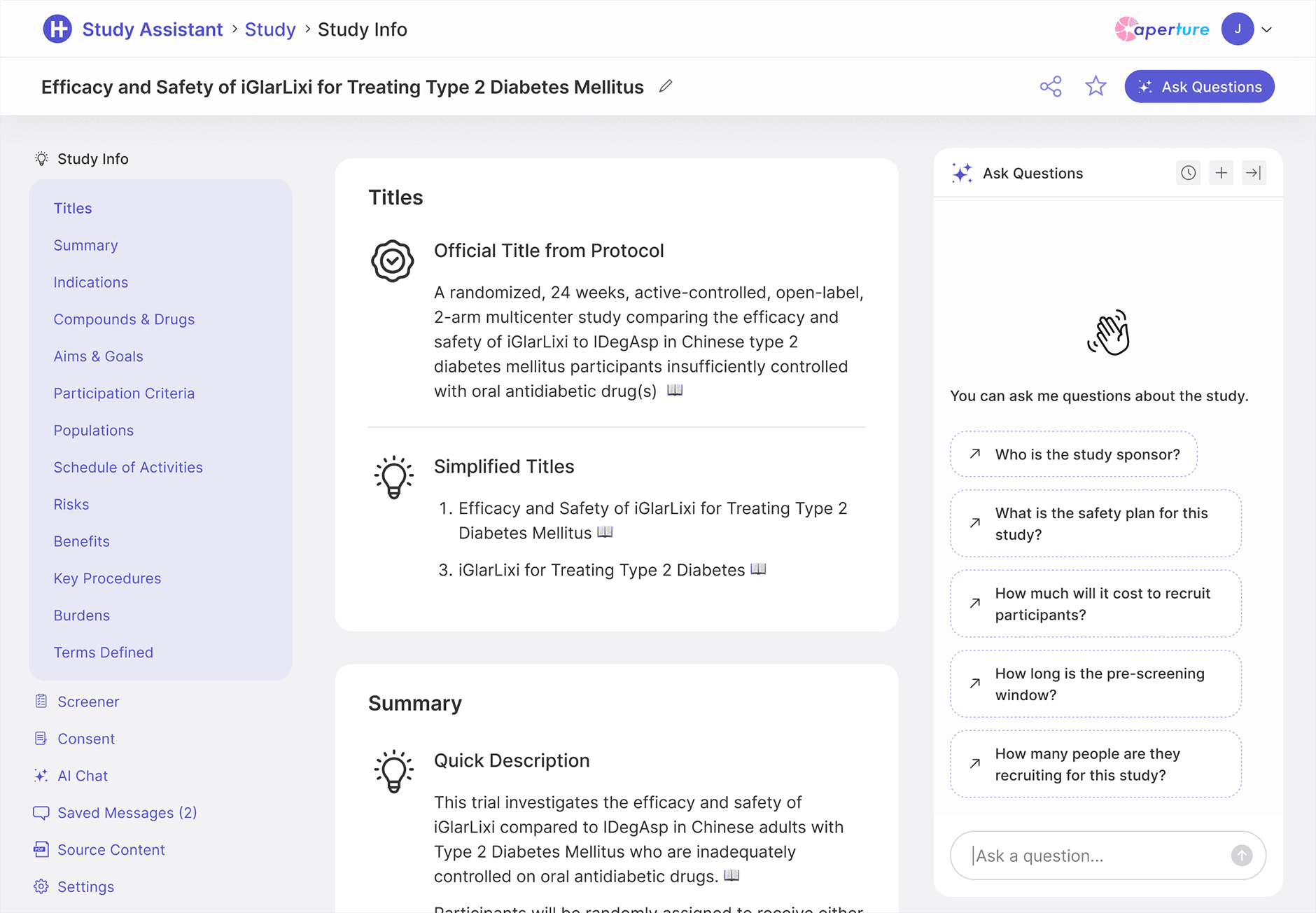
Inside the Study Assistant
The assistant is the interface. The knowledge base is the foundation.
- Study information is organized for fast review.
- Questions stay connected to the study in view.
- Source content remains available for verification.
Protocol intelligence for every role
Find the answer without losing the evidence.
Evidence-linked answers
Move from a plain-language answer to the protocol section, table, criterion, footnote, or supporting artifact behind it.
Structured study views
Navigate eligibility, Schedule of Activities, procedures, endpoints, assessments, arms, epochs, and operational dependencies.
Role-aware guidance
Give clinical development, sites, data management, biostatistics, medical writing, and vendors the context each role needs.
Version and amendment awareness
Keep answers aligned to the protocol version in use and identify what changed when an amendment is introduced.
Connected study knowledge
Bring the protocol, investigator brochure, SAP, lab and operational materials, regulatory feedback, sponsor decisions, QA findings, and approved evidence into one governed knowledge layer.
Reviewable by design
Retain source provenance, confidence, QA status, audit history, and optional expert consensus for higher-assurance use.
What teams ask
You ask the same questions, so automate them.
Use HumanTrue to not only automate answers to these questions, but to provide a consistent way to quickly see these details across a library of studies.
Quick answers without the PDF overload
Stop wasting time manually searching through PDF files. HumanTrue understands protocols and also knows clinical research. We understand what it is you're looking for and generate insights within minutes of uploading a protocol.
- Prepare for a study startup meeting by reviewing key details like phase, indication, number of participants, eligibility criteria, and the study goals.
- Start a feasibility analysis by reviewing the schedule of activities.
- Create a list of labs specified in the protocol and see if any parameters deviate from the standard.
- Start your recruiting efforts by understanding the population characteristics and the specific indications studied.
- Analyze patient burden by quickly looking at the number of clinic visits, procedures, and read the analysis of risks.
Useful from design through delivery
One study.Many questions.One governed knowledge base.
Clinical development
Review design intent, eligibility, endpoints, estimands, procedures, and protocol assumptions.Study operations and sites
Clarify visit requirements, windows, participant pathways, burden, training needs, and escalation points.Data and statistics
Connect assessments and endpoints to data collection, analysis requirements, SAP development, and downstream specifications.Medical writing and content
Reuse verified protocol content in ICFs, plans, study materials, translations, and amendment updates.
Controlled customer access
Product intelligence stays inside the governed environment.
Enterprise controls
- Study-level and role-based access controls.
- Isolated customer environments.
- No customer data used to train or fine-tune external models.
- Traceable answers, review status, and audit history.
Start with one protocol