Open, governed study infrastructure
One study knowledge base. Every downstream use.
The study knowledge architecture
Documents become a governed system of knowledge.
Evidence
Study documents
Protocol, investigator brochure, SAP, lab manuals, operational materials, feedback, and amendments.Foundation
QA'd USDM + extensions
Deterministic structure, semantic relationships, sponsor libraries, and recorded decisions.Knowledge
Governed study context
Source evidence, versions, review status, dependencies, and approved interpretation.Use
Answers + outputs
Study Assistant, documents, CRFs, system inputs, amendment impact, and simulation evidence.
Private AI architecture
Customer content stays inside a controlled boundary.
 SOC 2Control environment and diligence evidence
- HIPAABusiness Associate Agreements available for customers who require them
 CDISC USDMStandards-aligned, portable study structure
HumanTrue controlled environment
- Customer content
- Private model inference
- Governed output
- EncryptedTLS 1.3+ and AES-256
- Controlled accessSSO, MFA, and RBAC
- RecoverableLogging, monitoring, and backups
Capabilities
One governed knowledge base for the work of study design and delivery.
USDM 4.0
Protocol ingestion, semantic modeling, extensions, versioning, sponsor decisions, and downloadable structured output.
Study plans
Data management, clinical monitoring, safety, risk, quality, communication, and diversity plans.
Participant materials
ICFs, assents, screeners, recruitment materials, training, study guides, and registry summaries.
Analysis and budgets
SAPs, estimands, ARS-ready metadata, billing plans, budget inputs, and coverage analysis.
Global content
Country-specific variants, plain-language adaptation, multilingual materials, and ISO 17100 translation workflows.
Study systems
Schedule, CRF, edit-check, IRT, CTMS, eCOA, and ePRO inputs tailored to downstream requirements.
Study Assistant
The role-aware interface to the study knowledge base, with structured views and evidence-linked answers.
Assurance and simulation
Protocol QA, USDM fidelity, amendment impact, executable study testing, audit trails, and expert consensus.
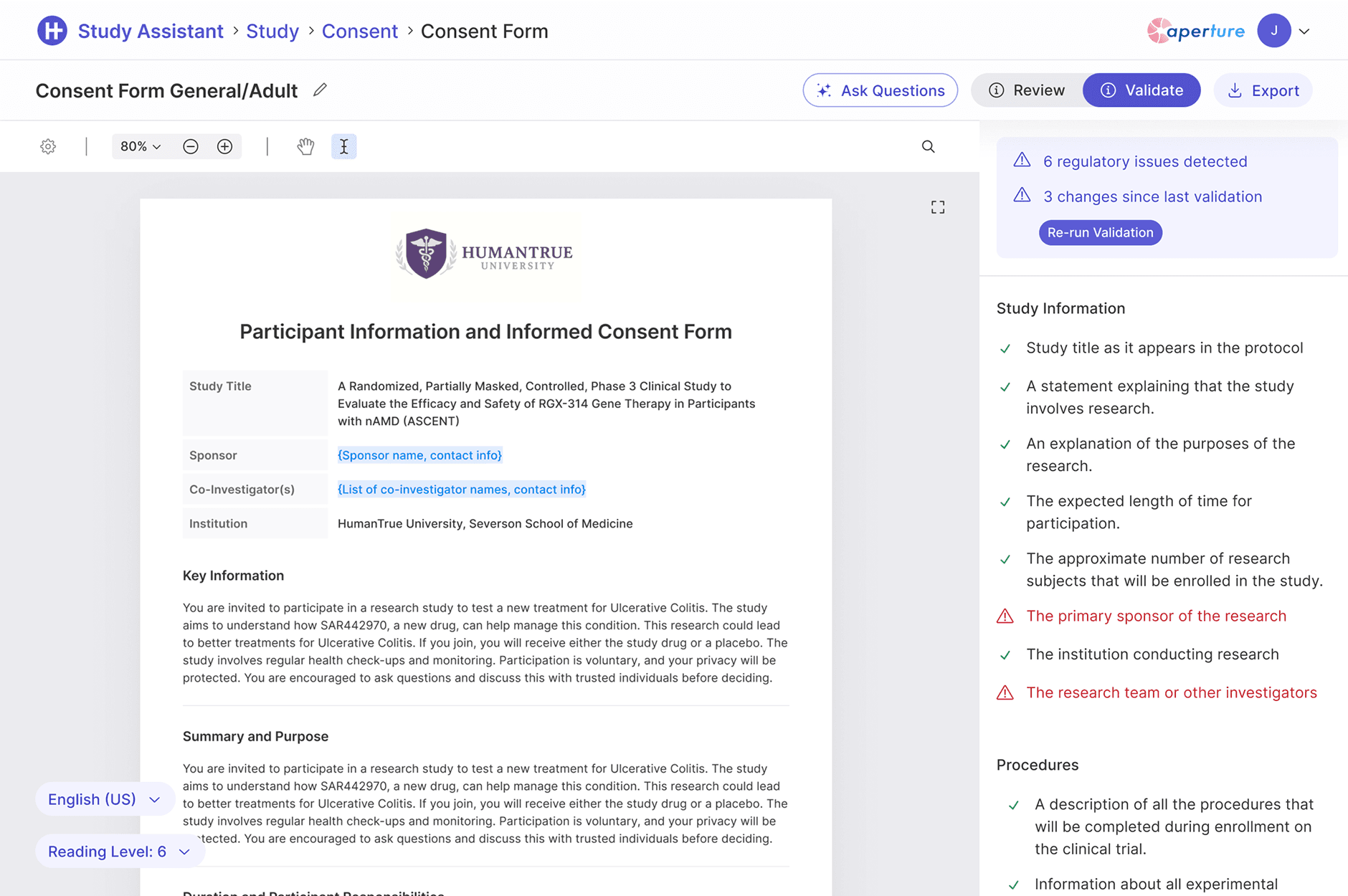
Document creation and review
Create the first draft. Keep the evidence beside it.
- Generate from governed study knowledge.
- Review requirements and validation findings in context.
- Adapt language, reading level, country, and template.
Downstream compatibility
HumanTrue is upstream of study operation.
- Medidata Rave
- TrialGrid
- Veeva
- IRT / RTSM
- eCOA / ePRO
- CTMS
- SAP / ARS
What remains controlled
- Sponsor owns its study data and study-specific content.
- HumanTrue retains its platform, reusable schemas, methods, and extensions.
- Downstream vendors retain their schemas and operational technology.
- No customer data is used to train or fine-tune external models.
Start with one protocol